
How common trees rank in wind
The University of Florida's "Selecting Coastal Plain Species for Wind Resistance" (FOR119, revised August 2026) sorts southeastern trees into four groups, from highest to lowest wind resistance, using hurricane damage studies and a survey of tree experts. Its Table 1 records the share of each species still standing after Hurricane Ivan struck the Florida Panhandle. The trees below all grow in the North Carolina Piedmont.
| Tree | UF wind group | Standing after Ivan |
|---|---|---|
| Sweetgum | Medium-high | 86% |
| Red maple | Medium-low | 76% |
| Pecan | Lowest | 76% |
| Water oak | Lowest | 72% |
| Bradford pear | Lowest | 68% |
| Loblolly pine | Medium-low | 66% |
| Southern red oak | Lowest | 60% |
| Tulip poplar | Lowest | 24% |
| Willow oak | Medium-low | not in Table 1 |
The publication's own caution is worth repeating: these lists should be used with care, because no species and no single tree is completely windproof. A tree's own condition still matters, which is why the warning signs on dead or leaning trees apply to every species here.
Water oak: big, fast and short-lived
NC State Extension's plant database describes water oak as a tree of 50 to 80 feet that may live only 30 to 50 years. It calls the species weaker wooded than most oaks and says its limbs are notoriously weak and at risk of breaking in high winds or winter snow and ice. The Extension's storm guidance lists water oak among the weak-wooded trees to avoid planting, and Florida's researchers put it in their lowest wind group. A water oak that has reached full size near a house deserves a regular look for dead limbs, cavities and fungus. See dead or leaning trees.
Willow oak: the street-tree oak
Willow oak is the oak with narrow leaves, 4 to 5 inches long and about an inch wide, that look more like a willow's than an oak's. NC State lists it at 40 to 75 feet, sometimes up to 100, fast-growing and long-lived, and suggests it as a street tree. The same entry warns that it's susceptible to wind damage, and Florida's rankings place it in the medium-low group. A healthy willow oak may well be worth trimming and keeping; a big one with dead wood over the roof is worth an inspection.
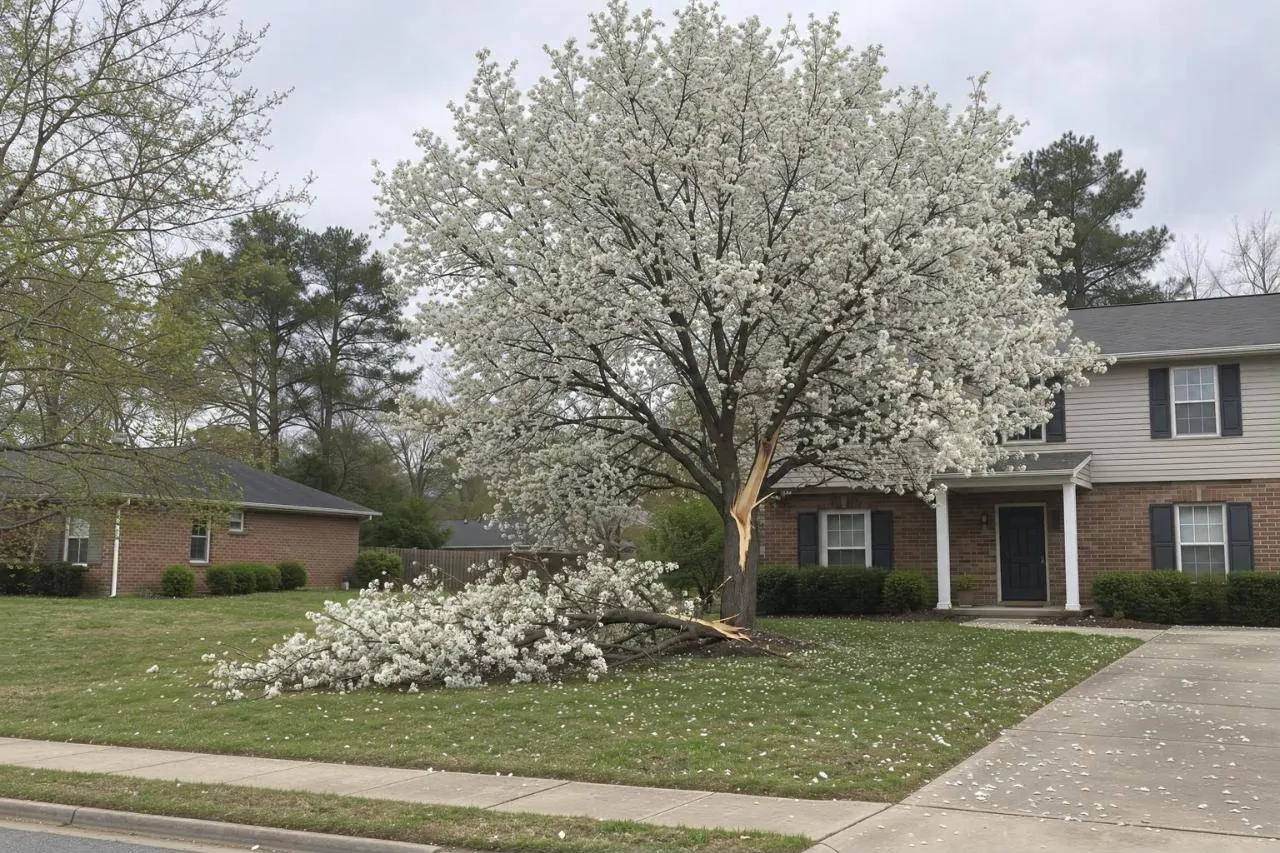
Bradford pear: built to break
NC State Extension calls Bradford pear the classic example of a weakly structured tree prone to self-destruction in winter storms. Its plant database explains why: the limbs shoot upward at steep angles from weak crotches that give way as the tree ages and under wind and ice, and a heavy wind or rainstorm is likely to split those tight forks in half. NC State calls the tree relatively short-lived and lists it as an invasive species in North Carolina, because Bradford pears that cross-pollinate with other pears revert to the invasive Callery pear.
The trees bloom white in early spring, from April to May. NC State calls the tree problematic and says alternatives should be considered. It names Eastern redbud, flowering dogwood, common serviceberry and American plum as native choices.
Sweetgum: sturdy, but messy
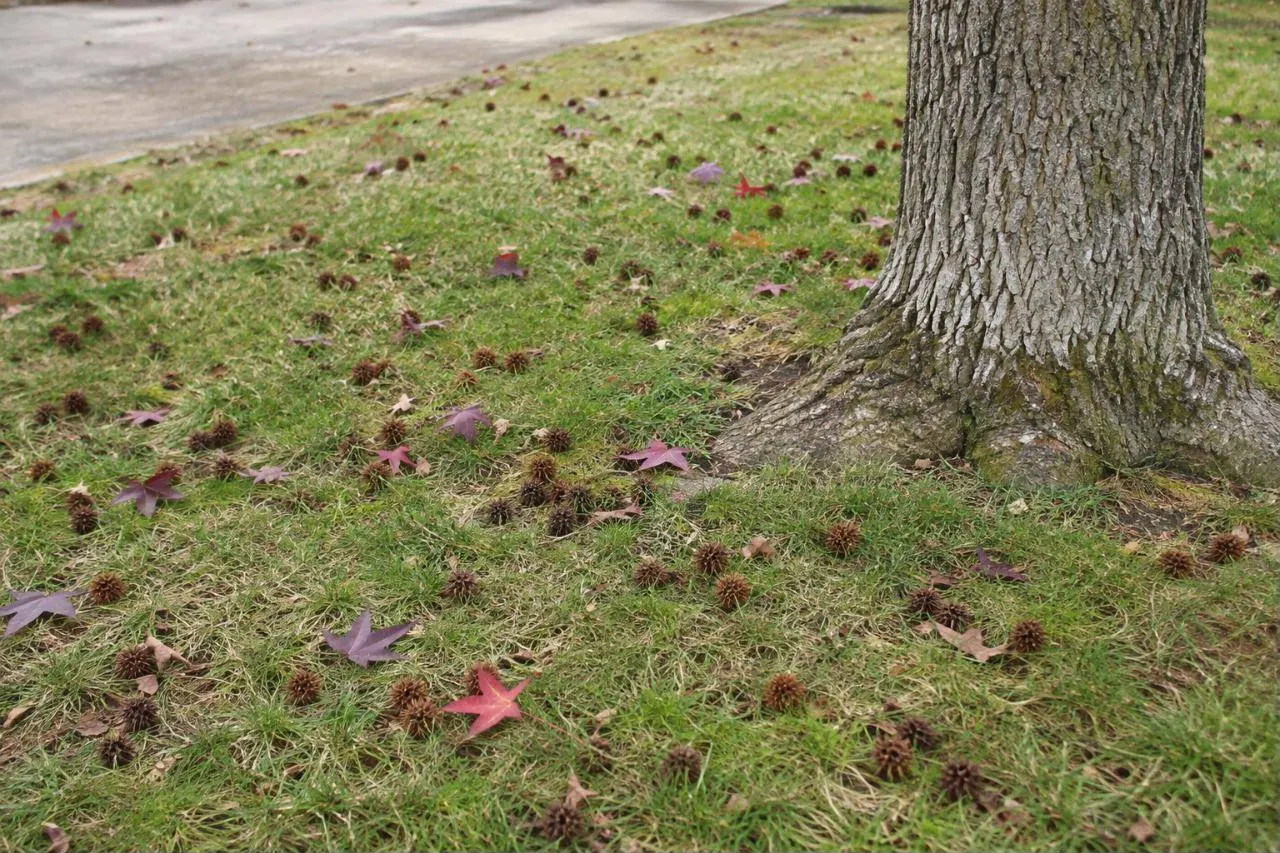
Sweetgum did best of the trees on this page in the Ivan count, at 86 percent still standing, and Florida's researchers put it in their medium-high group. It's a big tree, 60 to 100 feet tall by NC State's figures, with star-shaped leaves of five to seven lobes and fall color that can mix yellow, orange, purple and red. Its complaints are different: NC State says the spiny fruit, called gumballs, is a litter problem in lawns and patios, and the tree has a shallow root system.
Loblolly pine
Loblolly is the most common pine in Union County and can live past 100 years, according to the county's urban forester. It sits in Florida's medium-low wind group, and 66 percent were standing after Ivan. Its bigger risks around homes are crowding, a newly opened edge, beetles and ice; the pine tree removal guide covers each.
Ice is the other test
Wind isn't the only thing that breaks trees in the Piedmont. In the December 2002 ice storm, Duke Power lost service to 62 percent of its customers at the peak, and state regulators found that the great majority of outages came from tree trunks or limbs falling onto distribution lines. NC State Extension's list of weak-wooded trees more likely to be damaged in wind, snow and ice names Leyland cypress, lacebark elm, Bradford pear, water oak, silver maple, green ash, willow and pecan. Its plant database separately says pecans are known for brittle branches prone to breakage, especially in wind.
Choosing a replacement
If you're replacing a tree that failed, NC State suggests species more resistant to wind and ice damage, including crape myrtle, bald cypress, hickory, ironwood, ginkgo and white oak. Plant it where it has room to grow, and keep big trees away from wires: Monroe's planting standards for development say canopy trees shall not be planted beneath or next to above-ground or overhead utility facilities, and Union Power asks members to avoid planting trees near power lines. Call NC 811 before digging the hole.
Storms that have hit Union County
- Hurricane Hugo, September 1989. An 87 mph gust at Charlotte's airport, tens of thousands of trees flattened across the western Piedmont, and a 6-month-old in Union County killed when a tree fell on his home, as the State Climate Office of North Carolina recounts.
- Ice storm, December 2002. Union County was among the counties in the federal disaster declaration for the severe ice storm of December 4 to 6, 2002, which left three-quarters of an inch to an inch of ice across Duke Power's affected service areas.
- Tornado, May 24, 2017. An EF1 southwest of Monroe, winds estimated at 100 mph, with most of the damage to trees, per the National Weather Service.
- Hurricane Florence, September 2018. Debris from the storm led the City of Monroe to remind residents of its yard-waste rules.
More on what to do when one of them puts a tree on the house: storm and emergency removal.
Questions homeowners ask
Which oak is which?
Look at the leaves. Willow oak's are slender and about an inch wide, much like a willow's. If you're not sure, the contractor or the Union County Extension center at (704) 283-3801 can help identify the tree.
Should every Bradford pear near the house come down?
Not automatically. NC State calls the tree problematic and short-lived, and a big one with a split or a lost limb is a strong candidate for removal.
Is a sweetgum dangerous?
In the hurricane data, it held up better than the other trees on this page. Most complaints about sweetgum are gumballs and shallow roots.
What should I plant instead?
NC State's list of wind- and ice-resistant choices is a good start, planted well away from overhead lines.
Every request sent through this site goes to one independent contractor around Monroe. The site has no crew.
- UF/IFAS Extension, FOR119, Selecting Coastal Plain Species for Wind Resistance (revised August 2026), Table 1 and Table 3.
- NC State Extension Plant Toolbox: water oak, willow oak, Callery pear, sweetgum, pecan. NC State Extension, Preventing and Managing Ice and Snow Damage to Landscape Plants (updated October 2026).
- Seiberling, Weakley and White, Common Trees of the North Carolina Piedmont (tulip poplar, red maple, southern red oak entries).
- Union County Extension, Pine Trees (January 2023). City of Monroe code, approved plan list standards. Union Power Cooperative, Carolina Country (January 2021).
- State Climate Office of North Carolina, Hurricane Hugo (2019); White House press secretary, North Carolina disaster declaration (December 12, 2002); N.C. Utilities Commission, December 2002 ice storm summary (2003); NWS Greenville-Spartanburg, May 24, 2017 tornadoes; City of Monroe, September 18, 2018 debris notice.