
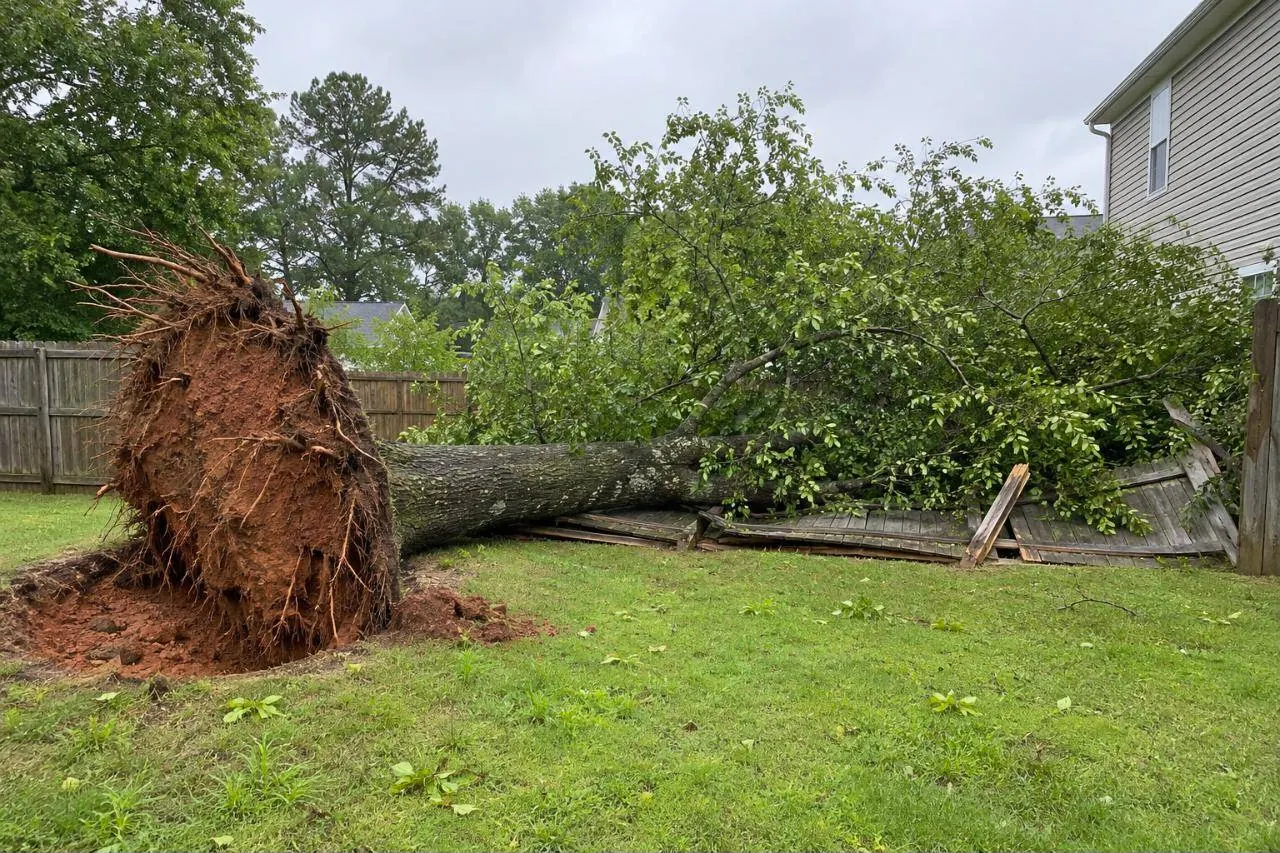
Why a fallen tree is an emergency
Falling trees kill people. Kent State University geographer Thomas Schmidlin counted 407 deaths from wind-related tree failures in the United States from 1995 to 2007, in a study published in the journal Natural Hazards. The largest share, 44 percent, were people in vehicles hit by a tree or driven into one lying across the road. Another 38 percent were outdoors, and 9 percent each were inside mobile homes and inside frame houses. In hurricanes and tornadoes, 40 percent of the victims were at home when the tree struck, against 13 percent in thunderstorms and other high winds.
Union County has lived it. Hurricane Hugo reached the Charlotte area in September 1989 with an 87 mph gust recorded at Charlotte's airport, and the State Climate Office of North Carolina writes that tens of thousands of trees were flattened across the western Piedmont. Among the deaths it describes, a sleeping 6-month-old child in Union County was killed when a tree fell on his home.
Ice does it more slowly but just as widely. Union County was among the counties named in the federal disaster declaration for the severe ice storm of December 4 to 6, 2002. In that storm, Duke Power had 1,042,034 of its 1,675,361 customers in the dark at the peak, 62 percent, after three-quarters of an inch to an inch of ice built up in every part of its system the storm hit. The N.C. Utilities Commission found that the great majority of outages came from tree trunks or limbs falling onto distribution lines. And on May 24, 2017, the National Weather Service in Greenville-Spartanburg rated a tornado that touched down southwest of Monroe and tracked northeast for more than 7 miles at EF1, with winds estimated at 100 mph. Most of its damage was to trees.
The first hour after a tree falls
- Clear the rooms beneath it. A trunk lying across a roof can shift or roll while the wind is still up or once its branches start coming off.
- Assume the wires are energized. Duke Energy tells customers to keep away from any line that has fallen or is sagging, and to treat every line, and any tree or limb in contact with one, as live. Report downed lines to your electric provider or call 911.
- Call the right utility. City of Monroe Energy Services: (704) 282-4600. Union Power Cooperative outages: (800) 794-4423. Duke Energy outages: 1-800-POWERON (1-800-769-3766).
- Leave tangled limbs alone. NC State Extension says never cut limbs tangled in power lines. Call the power company instead.
- Photograph before anything moves. The N.C. Department of Insurance says to photograph and list the damage before making temporary repairs. Get the tree, where it came from, the roof, siding, fence and car, and any water coming inside.
- Call your insurance company. Find out what the adjuster wants to see while the tree is still in place.
- Now book the removal. Getting a trunk off a damaged roof without adding to the damage takes skill and equipment. Tell the contractor exactly what is lying on what.
Whose tree is it?
- Your own tree on your own property. Removal is yours to arrange, and your policy decides what's covered.
- A neighbor's tree on your house. The Insurance Information Institute says that if it lands on your home, you file with your own insurance company. Your insurer may then go after the neighbor's insurer, a process called subrogation, which sometimes happens when the tree was in poor health or not properly maintained.
- A tree from the street side. If it may have grown on city right-of-way, call the City of Monroe at (704) 282-4500 before cutting, so the city can say whose it is.
- A tree across a line. The utility comes first, every time.
How insurance usually handles fallen trees
In 2010 the Insurance Information Institute summed up how standard homeowners policies usually treat trees:
- Wind or hail drops a tree on the house. The damage to the building and its contents is covered. Hauling the tree away is covered too, generally to a cap somewhere around $500 to $1,000 that varies by company and policy type.
- The tree lands without striking an insured building. In that case there's generally no coverage for cleanup, though some insurers will pay to clear a tree that blocks a driveway or an access ramp.
The N.C. Department of Insurance's storm guidance says much the same in plain terms: most companies will pay, up to a limit, to remove a tree from a damaged structure, but won't pay to remove one from your yard. It tells homeowners to check with their agent or company for the amount. The department can be reached at (855) 408-1212. Your own policy and deductible decide the real answer, and a contractor can't tell you what your policy covers.
Storm debris at the curb
After Hurricane Florence in September 2018, the City of Monroe reminded residents how its yard waste pickup works. Storm debris was to be placed behind the curb line or the edge of the pavement, never on the street, without blocking drainage. Building material such as roofing goes to a demolition landfill and is the responsibility of the contractor doing the repair, so it has to be kept apart from limbs and brush.
The ordinary rules still apply between storms: limbs no longer than 4 feet and no thicker than 6 inches, and nothing cut by a commercial tree trimmer. When you hire storm work, ask whether the price includes hauling everything away. The city can announce different arrangements after a major storm, so watch its news page.
Price gouging after a declared emergency
North Carolina's price gouging law takes effect when the governor declares a state of emergency, and it makes it illegal for businesses to charge excessively high prices during the crisis. The Attorney General's office takes complaints at 1-877-5-NO-SCAM and at ncdoj.gov/pricegouging.
Tree work has been part of those cases. After Hurricane Florence, homeowners in Castle Hayne said a tree company billed them $14,500 to remove two fallen trees, a price they said they never agreed to; a 2019 consent judgment barred the company and two of its people from doing tree removal in North Carolina. In December 2024, the state Department of Justice sued a tree removal company for price gouging a Hendersonville couple out of $25,500.
What commonly goes wrong
- Cutting before photographing. Your insurer may want to see the tree where it landed.
- Getting close to wires. A line can be live even while the power is off.
- Cutting wood under tension. A bent trunk or a limb pinned under weight can spring hard when it's cut. Leave it to an experienced crew.
- Limbs mixed with roofing or fence boards. The city treats building debris as the repair contractor's job, separate from yard waste.
- Agreeing to work with no price on paper. Get the scope, price and cleanup in writing, even in a hurry.
Who this guide isn't for
For a tree that's still up but has you worried, read dead or leaning trees. To get ready for the next storm, see tree trimming and Union County trees and storms. Anyone injured or trapped: 911 comes before everything else.
Questions homeowners ask
Can I saw the tree off the roof on my own?
It isn't worth it. The weight of a trunk resting on rafters shifts in ways that are hard to predict, and a cut made in the wrong place can send it deeper into the house. Let a crew with rigging or a crane take it off.
Will insurance pay to remove a fallen tree?
When it struck the insured house, the Insurance Information Institute says removal is usually paid to a cap of roughly $500 to $1,000. One that came down only on the lawn usually isn't. Your policy has the final word.
The power is out and a limb is on my service line. Who fixes that?
Your electric provider. Report it to Monroe Energy Services, Union Power or Duke Energy, whichever serves you, and keep everyone away from the line until they've been.
Does the city pick up storm debris?
After Florence, Monroe pointed residents to its normal yard waste guidelines, with debris placed behind the curb. Limbs cut by a hired crew are the contractor's to haul. Questions go to Solid Waste at (704) 282-4565.
Each request made here goes to one independent local contractor. This site does no tree removal of its own.
- Thomas W. Schmidlin, Kent State University: study of U.S. deaths from wind-related tree failures, 1995 to 2007, in Natural Hazards, volume 50, pages 13 to 25 (2009).
- State Climate Office of North Carolina, "How Howling Hugo Became the Western Piedmont's Worst Hurricane" (2019). White House press secretary, North Carolina disaster declaration (December 12, 2002). N.C. Utilities Commission with the Public Staff, executive summary on how electric utilities responded to the ice storm of December 2002 (September 5, 2003). National Weather Service Greenville-Spartanburg, May 24, 2017 tornadoes.
- Duke Energy, winter storm release (January 14, 2022); City of Monroe Energy Services FAQ; North Carolina's Electric Cooperatives, Report an Outage. NC State Extension, Preventing and Managing Ice and Snow Damage to Landscape Plants.
- Insurance Information Institute, information on insurance for fallen trees (July 22, 2010). N.C. Department of Insurance, storm claim guidance.
- City of Monroe, Yard Waste and Debris Collection Information (September 18, 2018); Yard Waste page.
- N.C. Department of Justice, price gouging release (February 18, 2025); consent judgment as reported by WECT (September 10, 2019).