
What to look for
The USDA Forest Service's guide "How to Recognize Hazardous Defects in Trees" sorts the trouble into seven kinds: dead wood, cracks, weak branch unions, decay, cankers, root problems and poor tree architecture. Walk around the tree and look up the trunk into the crown for each one.
- Dead wood. The guide is blunt that dead trees and large dead branches must be removed right away. A dead limb can come down on a calm day.
- Cracks. A deep split in the trunk or a big limb is, in the guide's words, extremely dangerous, because it shows the tree is already failing.
- Weak unions. Two stems rising from the same point with bark pinched between them are poorly joined and can split apart.
- Decay. Mushrooms, conks or shelf-like brackets growing on the trunk or root flare, or a cavity where wood is missing, point to rot inside.
- Cankers. Sunken, dead patches of bark. One that wraps more than half way around the trunk may make the tree hazardous.
- Root problems. Twig dieback, dead wood in the crown and leaves that come out small or off-color are common above-ground clues. Roots cut for a driveway, paved over, or driven and parked on are a frequent cause.
One defect is a reason for a closer look. More than one on the main stem is a different matter: the Forest Service says to assume such a tree is extremely hazardous.
When a lean is new
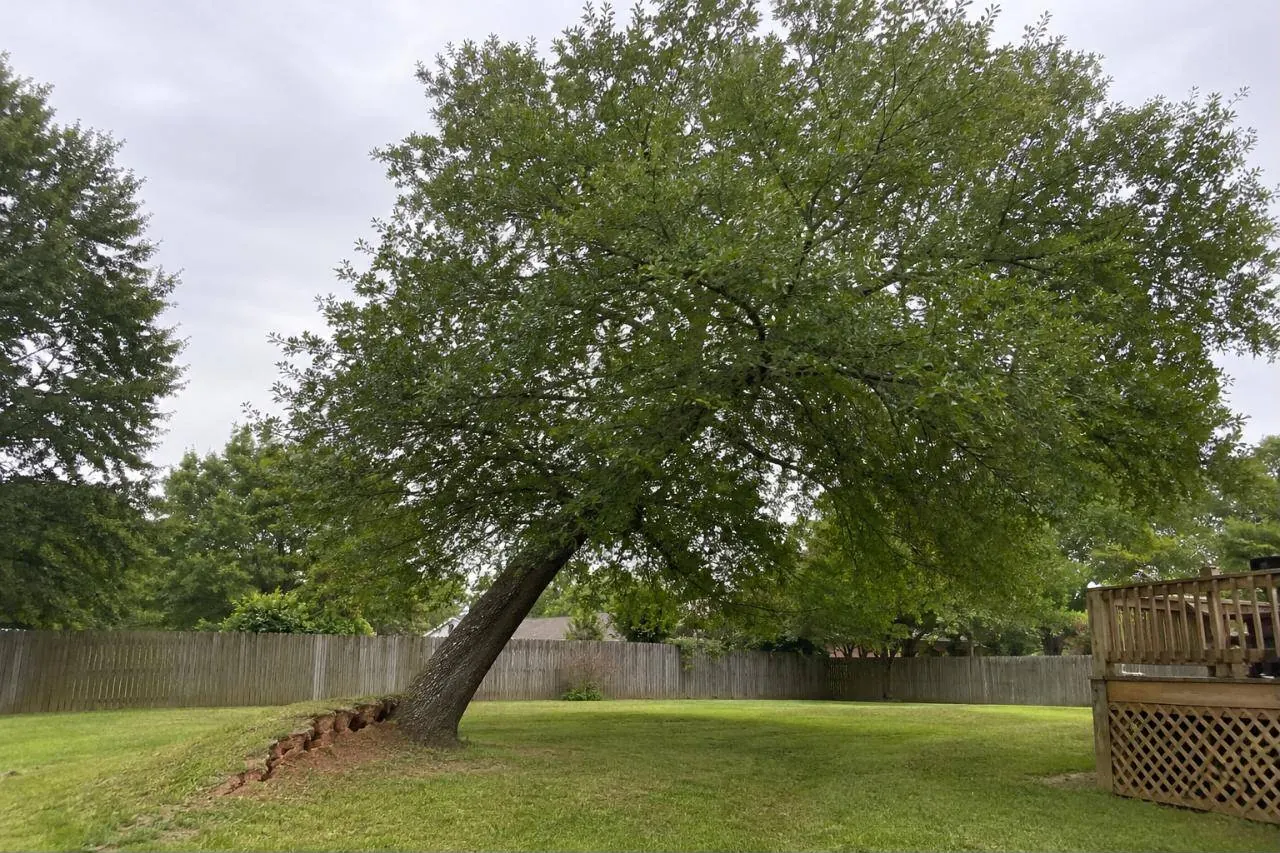
Plenty of trees grow at an angle for decades and stay put. What matters is whether the lean is new. Darrell Blackwelder, a retired Cooperative Extension director in Rowan County, wrote that trees unnaturally leaning from the ground up should be considered hazardous, and that soil cracks and heaving are clues that the roots can no longer be trusted to hold the tree.
The Forest Service guide says the same: a tree leaning with freshly exposed roots, moving soil or a mound of soil near its base calls for action, and a mound like that means the tree has recently begun to lean and may soon fail. Look on the side away from the lean. A ridge of lifted, cracked soil there is the root plate starting to come up.
The N.C. Forest Service's bulletin on storm-damaged pines draws a line between young and old trees. Young trees that are bent or leaning will usually straighten within the first growing season. Mature trees with visible root damage, especially with a lean greater than 45 degrees, are expected to die.
Water oaks don't last long
Water oak is worth watching as it gets big. NC State Extension's plant database says it usually reaches 50 to 80 feet, may live only 30 to 50 years, and is weaker wooded than most oaks, with limbs it calls notoriously weak and at risk of breaking in high winds or winter snow and ice. The same entry says water oak is susceptible to oak wilt, often with fatal results. In the University of Florida's wind rankings, water oak sits in the lowest of four wind-resistance groups.
A large water oak over the house that's dropping limbs, has a cavity or fungus at the base, or shows dead wood in its crown is a strong candidate to have looked at now. See Union County trees and storms.
Pines that turn red
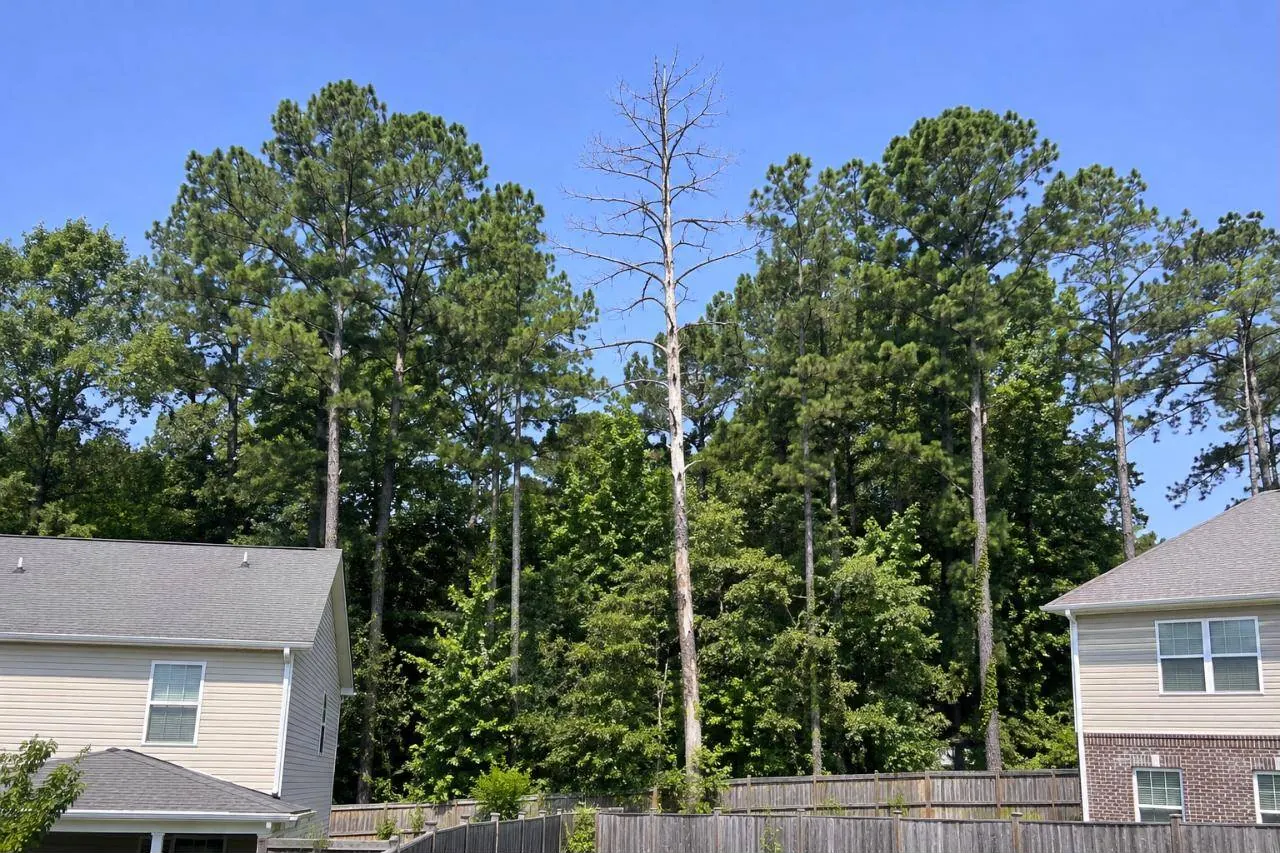
Needles fading from green to yellow to red are a classic sign of a bark beetle attack, NC State says. Its Extension publication on pine bark beetles names the usual culprits in the state: the southern pine beetle, three species of Ips engraver beetles and the black turpentine beetle.
- Pitch tubes. Small blobs of resin on the bark are a good sign that beetles are attacking, though stressed trees may not make them.
- Needle color. Infested pines fade from green to light green, then yellow, then red.
- What sets it off. Ips beetles go after trees already under stress from drought, crowding, storm or fire damage, or lightning. Black turpentine beetles favor recently wounded trees.
Union County's urban forestry page warns that pine beetle infestations may not be visible without professional help, and the county's urban forester, writing for the Union County Extension center, says there is no effective pesticide treatment for pine bark beetles. Ips beetles can kill pines within weeks, North Carolina officials warned in 2025. A dead pine near the house, the driveway or the street is a removal to plan soon. More on pine tree removal.
After a storm
A tree that rode out the storm isn't necessarily safe. The defects in the Forest Service checklist above are the ones to look for in the days after high wind or ice: new cracks in the trunk, limbs broken and hanging, and soil lifted at the base of a tree that now leans. The N.C. Forest Service's bulletin on storm-damaged pine stands, written for woodland owners, says heavily damaged trees are best removed as soon as possible. Its order for salvaging timber puts trees with sprung roots, broken tops and leans past 30 degrees first, so the worst-hurt trees are cut before insects and fungi spoil the wood. That list is about timber, not houses, but the same injuries on a pine beside your home are a reason to have it looked at soon.
A neighbor's dead tree
When the dying tree hanging over your roof stands on the lot next door, the first step is a conversation with whoever owns it. Should it come down on your house anyway, the Insurance Information Institute says your own insurer takes the claim. That insurer may later try to recover from the neighbor's company, a step the Institute says sometimes follows when a tree had been sick or neglected. Dated photos of its condition beforehand can help.
Trees on county land are handled differently. Union County says its urban forester may inspect a tree on county-owned property to decide whether it's hazardous: (704) 283-3510.
What commonly goes wrong
- Waiting for it to fall. A new lean with heaving soil is the tree telling you it's moving.
- Judging by the green leaves. A tree with a full crown can still have a cracked trunk or rotten roots.
- Climbing a dead tree. Dead wood is brittle. Ask the contractor how they plan to take it down.
- Leaving a beetle-killed pine "until later." It only gets drier and more brittle.
Questions homeowners ask
My pine went brown in a few weeks. Is it dead?
Very likely. A fast fade from green to red is the pattern NC State describes for bark beetle attacks. Have it looked at, and if it's near the house, plan the removal soon.
Is every leaning tree dangerous?
No. A tree that has grown at a slant for years may be stable. A lean that's new, or one with cracked and lifted soil at the base, is the warning sign.
Do I need a permit to take down a dead tree in Monroe?
The city pages read for this site show no homeowner removal permit. Ask Planning at (704) 282-4520 if the tree is near the street or you aren't sure where your lot ends.
Can a dead tree be saved?
A dead tree, no. A tree with one dead limb or a small defect often can be pruned and kept. Several defects on the main trunk tip the balance the other way, by the Forest Service's guide.
This site connects you with one independent local contractor and does none of the tree work itself.
- USDA Forest Service, Northeastern Area, How to Recognize Hazardous Defects in Trees (NA-FR-01-96).
- Darrell Blackwelder, "Evaluate trees before they become a hazard," Salisbury Post, January 8, 2022.
- N.C. Forest Service, Managing Storm Damage to Southern Yellow Pines (TRB-002, August 2015).
- NC State Extension, Plant Toolbox entry for water oak; Pine Bark Beetles (August 2022). UF/IFAS Extension FOR119.
- Union County, Urban Forestry page. Union County Extension, Pine Trees (January 2023). Public Radio East, May 7, 2025.
- Insurance Information Institute, information on insurance for fallen trees (July 22, 2010).