
Removal: national figures
For cutting down a single tree, Thumbtack's removal cost guide (last updated March 24, 2026) gives a national average of $450 to $1,450. Cheaper jobs land around $373 to $432; expensive ones reach $2,500 to $3,300. If the stump is taken out in the same job, the typical span becomes $884 to $1,627. Rather than height, the guide prices by how thick the trunk is and how wide the canopy spreads:
| Spread of the crown | Trunk below 12" | Trunk 12"–24" | Trunk 24"–36" |
|---|---|---|---|
| Narrower than 30 feet | $226–$596 | $517–$1,364 | $976–$2,573 |
| Wider than 30 feet | $359–$946 | $808–$2,132 | $1,562–$4,117 |
The guide doesn't break prices out by kind of tree, so a pine and an oak of the same trunk and canopy size fall in the same row.
Trimming: national figures
A trimming job costs $402 to $1,158 on average nationally, says Thumbtack's separate trimming guide (updated October 23, 2026), with averages stretching from $186 at the low end up to $2,456 at the high end. Height pushes it up: a short tree of 5 to 10 feet is $474 to $848, while anything taller than 40 feet is $1,126 to $1,957. The full height table is on tree trimming.
Stump grinding: national figures
The March 2026 removal guide also prices grinding by itself, for a tree that's already down. A stump less than a foot across runs $267–$354; one a foot to two feet across, $324–$443; two to three feet, $355–$486; and three to four feet, $372–$494. More on stump grinding.
Worked example: a big oak over the back deck
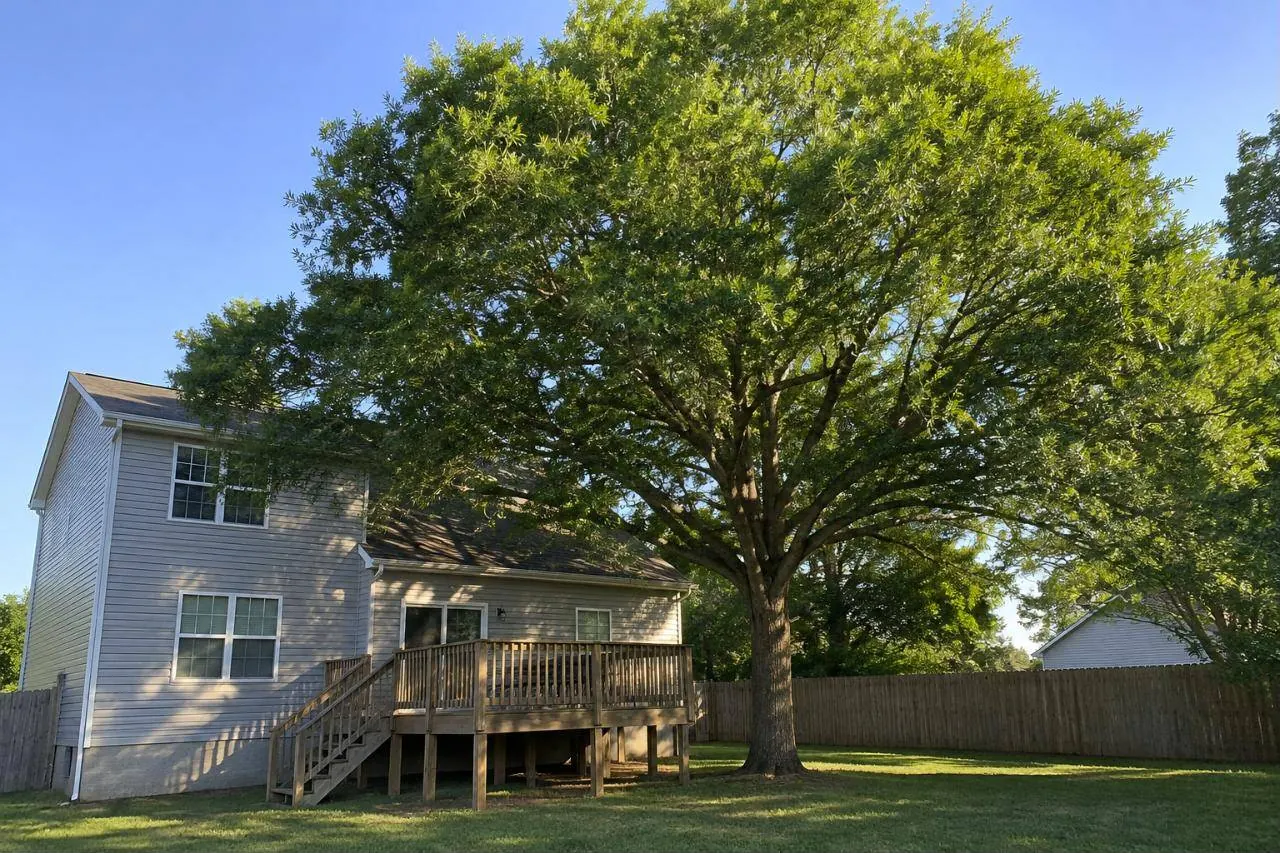
Picture an oak with a trunk about 20 inches across at chest height and a crown about 40 feet wide hanging over the deck and the back of the roof, and you want the stump ground too.
- Taking the tree down (trunk in the 12"–24" tier, crown wider than 30 feet): $808–$2,132.
- Grinding a stump in the 12"–24" tier: $324–$443.
- Added up, using the national tiers: $1,132–$2,575.
Those tiers assume ordinary conditions. With a deck and a roof underneath, the wood has to come down in pieces on ropes rather than be dropped, which pushes a job toward the top of its range or past it. In Monroe, hauling everything away has to be part of the price, because the city doesn't pick up wood cut by a hired crew.
What moves a Monroe quote
| Factor | Why it matters here |
|---|---|
| Trunk and canopy | Thumbtack's ranges climb from $226 for the smallest, narrowest trees to $4,117 for the largest, widest ones |
| What's below | A roof, deck, fence or wires underneath means lowering wood instead of dropping it |
| Access | A fenced back yard or a narrow gate limits where a truck, lift or chipper can go |
| Hauling | Monroe doesn't collect trees, limbs or brush cut by commercial tree trimmers, and bans open burning, so all the wood leaves on the crew's trucks |
| The stump | Ground at the same visit or left; grinding is priced by diameter |
| Power lines | A tree near a line may need the city's Energy Services, Union Power or Duke Energy to act first |
| After a storm | Lifting a trunk off a roof or out of a fence line takes longer and carries more risk than felling a tree that's still upright |
| How many trees | Bundling several into one visit spreads out the cost of bringing a crew and machines |
When insurance pays part of it
According to the Insurance Information Institute's 2010 guidance, a standard homeowners policy pays for the damage when wind or hail sends a tree into an insured house, and pays to take the tree away up to a cap that's generally in the $500 to $1,000 range, set by the company and the policy. A tree that comes down without striking an insured building generally gets nothing for cleanup. The N.C. Department of Insurance puts it the same way: most companies pay up to a limit to remove a tree from a damaged structure, not from your yard. See storm and emergency removal.
What the written quote should list
- Which trees, where they stand, what kind they are and about how thick each trunk is.
- How each comes down: felled in one piece, dismantled from the top, or craned out.
- Stump grinding, yes or no, and the depth.
- Hauling: whether brush, logs and chips all go, or some stay with you.
- Who calls NC 811 before any grinding.
- How the lawn, driveway, fence and anything under the tree will be protected.
- The total price, any deposit, and when the rest is due.
Questions homeowners ask
Why isn't there a Monroe price on this page?
No local contractor's prices were collected for this site. National figures give a starting range; the written quote for your tree is the local number.
Is the biggest tree always the priciest?
Not necessarily. Open lawn on every side can make a large oak cheaper to remove than a smaller tree whose crown hangs over a deck and the roof.
Is there a city permit fee to add?
No homeowner tree permit turned up in the Monroe pages read for this site, so there's no permit fee in the example above. If your home is in another town, ask its planning office.
Can I save money by keeping the wood?
Sometimes. Hauling is part of the job, and in Monroe the city won't take contractor-cut wood. Ask for the price both ways.
Requests made here reach one independent local contractor, who sets their own price. The site does no tree work.
- National figures from Thumbtack: removal guide (last updated March 24, 2026) and trimming guide (last updated October 23, 2026).
- City of Monroe, Yard Waste page; Open Burning Rules (ordinance O-2003-35).
- Insurance Information Institute, information on insurance for fallen trees (July 22, 2010). N.C. Department of Insurance, storm claim guidance.