
Is a permit needed?
For a tree on your own lot in Monroe, probably not, but check. The city and county pages read for this site turned up no permit that a homeowner needs before cutting down a yard tree. The tree material in Monroe's code is a list of planting standards for new development, and Union County's urban forester reviews new developments for tree preservation and replanting rather than single trees in existing yards.
Three situations are worth a phone call before anyone starts a saw:
- The tree is near the street. If it grows between the sidewalk and the curb, or you can't tell where your lot ends, ask the city. Monroe's Code Enforcement Division handles right-of-way maintenance, and Planning is at (704) 282-4520.
- Your home is in another town. Indian Trail, Wingate, Marshville and Unionville each have their own planning office, with numbers on the local rules page.
- Your neighborhood has an association. Some subdivisions have their own rules about trees. Read yours or ask the board.
How a tree comes down near a house
A crew picks its method from three things: how tall the tree is, what lies under its crown, and how much open ground there is to put wood on.
- Dropped in one piece. Where there's clear lawn longer than the tree is tall, a cutter can notch the trunk and fell it in a chosen direction, then buck it up on the ground. It's the fastest way, and the one that needs the most room.
- Taken apart from the top. Over a roof, a deck, a fence or the yard next door, a climber or a bucket truck removes the limbs first and then the trunk in short lengths, each one tied off and lowered on a rope.
- Picked out with a crane. A big tree leaning over a house, with nowhere safe to lower pieces, sometimes comes out by crane. Whether that works depends on the street, the overhead wires and where the crane can set up.
Before you agree to anything, ask which method the contractor plans and where each piece is going to come down. Most of the cost, and most of the danger to the house, follows from that one answer.
Where all the wood goes
This is the part of a Monroe removal that surprises people. The city collects yard waste once a week, on the same day as garbage, but its own yard-waste page sets tight limits: tree limbs no longer than 4 feet and no more than 6 inches across, with root balls and trunks or branches thicker than 6 inches refused. And it says plainly that trees, limbs and brush cut by commercial tree trimmers or commercial lawn care services aren't collected, because trimmings cut by contractors are the contractor's responsibility.
Burning isn't the answer inside the city either. Monroe prohibits open burning under ordinance O-2003-35, and its fire department doesn't permit burning yard waste where public pickup is available. Outside town limits, the N.C. Forest Service and state air rules decide when brush can be burned; see the local rules guide.
So the written price should say what leaves your property. Usual choices:
- Everything chipped and hauled away, and the yard raked.
- Brush chipped and hauled, with the trunk cut into firewood lengths and left for you.
- Chips dumped in a pile on site for mulch, if you want them.
Trees near power lines
Union County homes get electricity from several providers, and the county lists Duke Energy, Union Power Cooperative, the City of Monroe and Pee Dee Electric. The three below publish their own guidance on trees near their lines.
- City of Monroe. The city trims trees along its power lines because, in its words, trees growing too close to overhead lines can threaten your safety and cause outages, especially in high winds and ice storms. Energy Services: (704) 282-4600.
- Duke Energy. Duke asks customers to contact it before pruning or removing trees near power lines, calling the work very hazardous. Its trees-and-safety page says a technician can disconnect the line to the house so you or a tree service can work safely, then reconnect it.
- Union Power Cooperative. The co-op's vegetation management department is at (704) 289-3145. In a 2020 member article it set 15 feet as its standard clearance around distribution lines.
Mention any wires near the tree when you call. It changes who does which part of the job and in what order.
The stump
Unless the price says otherwise, a removal leaves a stump. Many owners have it ground at the same visit. A grinder cuts below ground, so state law calls for notice to NC 811 three full working days before digging, and the locate is a free call. More on stump grinding.
What commonly goes wrong
- Nobody planned for the wood. If hauling isn't written down, a pile of logs and brush at the curb can sit there, because the city won't take contractor-cut debris.
- Debris in the street or ditch. Monroe asks that brush and storm debris go behind the curb line or the edge of the pavement, never onto the street, and that piles not block drainage ways.
- Wires forgotten. A limb resting on the service line to the house needs the utility first.
- Buried lines. Irrigation pipe, low-voltage lighting and a wire to a shed don't show up as utility marks. Point them out before work starts.
- A pine taken out of a crowded stand. Removing some pines can leave the rest exposed to wind they never had to stand up to; see pine tree removal.
What removal costs
Thumbtack's national guide, updated March 24, 2026, puts the usual cost of cutting down one tree at $450 to $1,450. Take the stump out too and the usual range becomes $884 to $1,627. It prices by trunk diameter and canopy width. Its smallest tier, a trunk below a foot thick with a crown under 30 feet wide, is $226 to $596. Its largest, a trunk two to three feet thick with a crown past 30 feet, is $1,562 to $4,117. These are national averages and not Monroe prices. All the figures are on what tree work costs.
Who this guide isn't for
A sound tree that's simply too close to the roof may only need cutting back; see tree trimming. If a storm has already dropped it on the house, start with storm and emergency removal. If you're clearing a wooded lot to build, that's land clearing under a building project, a different job with its own rules, so talk to the planning office for your town first.
Questions homeowners ask
Will the city pick up the wood if I cut the tree myself?
The limbs, if you cut them to the city's limits: no longer than 4 feet and no thicker than 6 inches, piled at the curb with nothing else mixed in. The city's yard-waste page says trunks and branches over 6 inches and root balls aren't accepted. Questions go to Solid Waste at (704) 282-4565.
Can a removal be done in one day?
Many can, but it depends on the tree, the access and the method. Ask the contractor how long they expect to be there and whether the stump is ground the same day.
Can I keep the firewood?
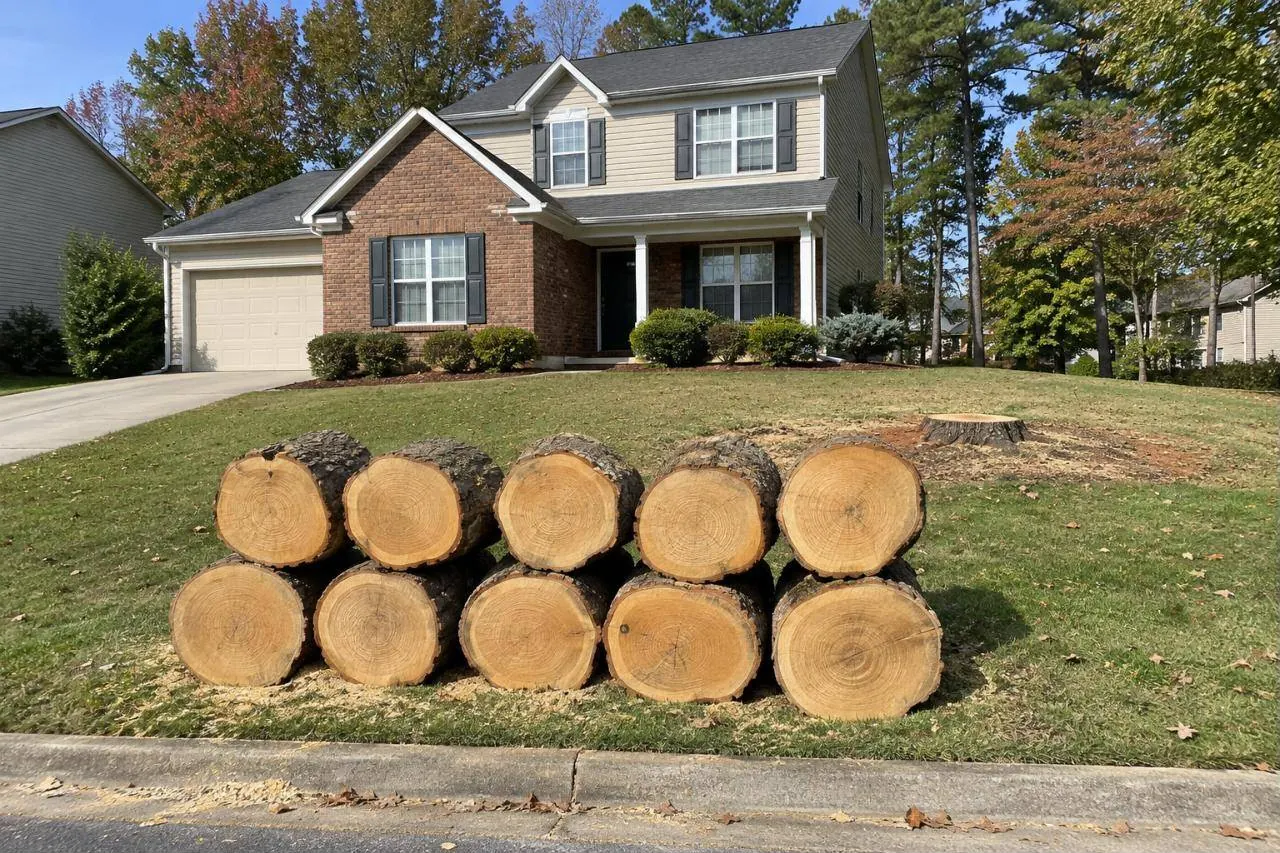
Usually, if you ask. Leaving the trunk in rounds can lower the hauling part of the price. Get it in writing either way.
The tree is in my neighbor's yard but leans over mine. Can I remove it?
Not on your own. It belongs to your neighbor, so start with them. If it falls on your house, the Insurance Information Institute says the claim goes to your own insurer first; see dead or leaning trees.
Requests sent through this site go to one independent contractor near Monroe. The site itself never touches a tree.
- City of Monroe, Yard Waste page (Garbage and Recycling); Yard Waste and Debris Collection Information, September 18, 2018; Monroe Fire Department, Open Burning Rules brochure (ordinance O-2003-35); Planning and Development page. Read November 2026.
- Union County, Urban Forestry page; Union County, Numbers to Know (electric providers).
- City of Monroe, Energy Services FAQ. Duke Energy, Trees and Safety. Union Power Cooperative, Carolina Country member pages (January 2020 and January 2021).
- North Carolina's Electric Cooperatives, Call Before You Dig (August 2023).
- Thumbtack, cost to remove a tree, updated March 24, 2026.