
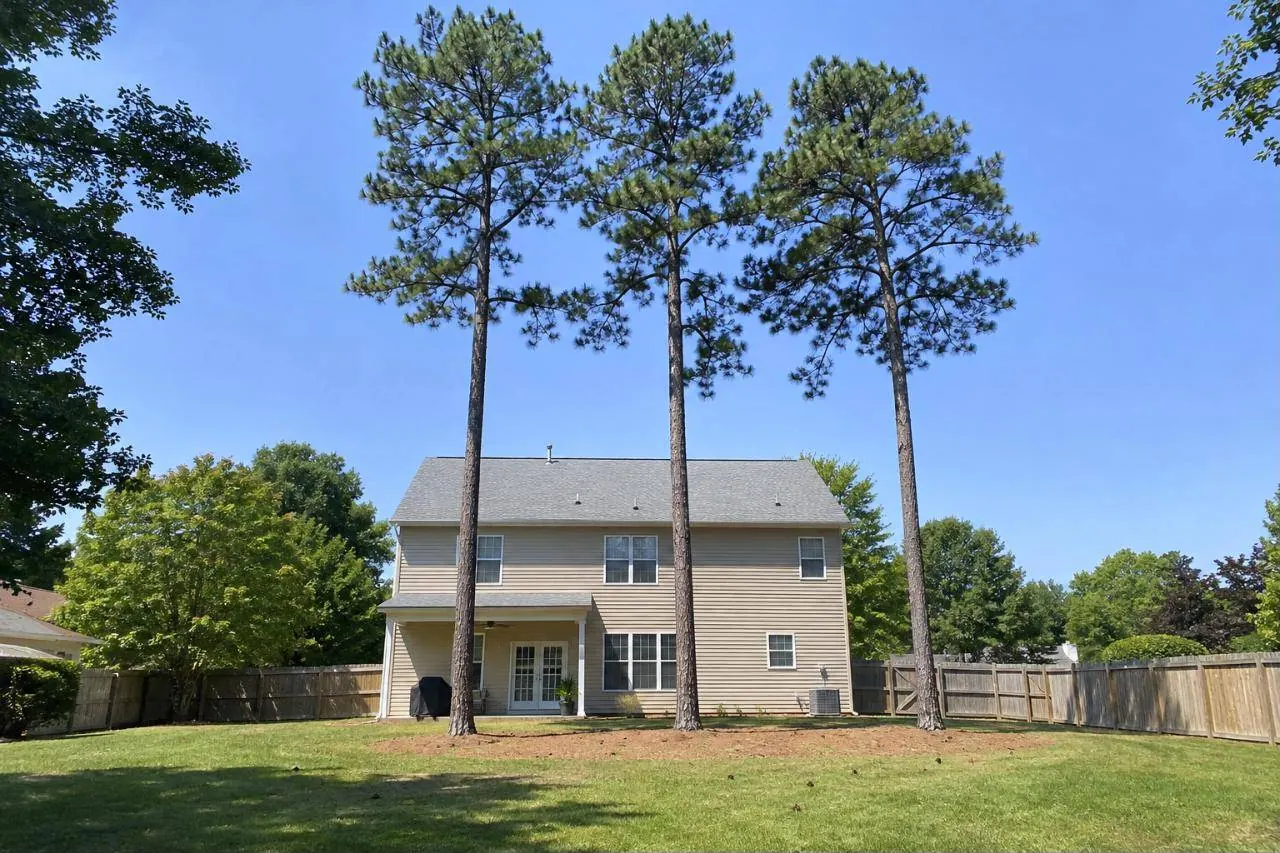
Loblolly, the county's pine
Loblolly is the most common pine in Union County and can live to be over 100 years old, according to the county's urban forester, writing for the Union County Extension center. The county has a lot of woods to grow them in: the same office counts over 150,000 acres of privately owned forest, a little more than a third of all the land in Union County.
In storms, loblolly sits in the middle. The University of Florida places it in the medium-low of four wind-resistance groups, one step above water oak's group, and 66 percent of the loblolly pines it tracked were still standing after Hurricane Ivan. Water oaks actually did a little better in that one storm, at 72 percent. Neither is windproof, and the researchers say no tree is.
Why subdivision pines blow over
The county's urban forester points out what happens when land goes from pine plantation to new homes: the thinning a plantation would get is skipped. The pines are left standing very close together, and they shade each other out faster, which weakens them.
The danger comes when part of that stand is cleared, for a new house, a road or a yard. Clearing some pines and opening a new edge causes a sudden change in local wind patterns, the forester writes, and exposing tall, skinny pines to wind they've never had to stand up to is the primary reason they get blown over.
That has two practical meanings for a homeowner. First, the pine that worries you most may be one that was in the middle of the woods until the lot next door was cleared. Second, removing a few pines from a tight group can leave the rest more exposed, so ask the contractor which trees will be left standing on the windward side, and why.
Which pines to keep
For homes surrounded by closely spaced pines, the urban forester's general advice is to pick the best 20 percent of the pines and remove the other 80 percent. He adds that the 20/80 prescription is very generalized and may not fit every yard. The point is to keep the straightest, healthiest trees with room to grow, rather than a thicket of thin ones.
For the pines that stay, he suggests keeping their root systems healthy, possibly with some extra water during droughts. Stressed pines are the ones beetles find.
Pine beetles
Pines in Union County and across North Carolina are under constant pressure from several species of pine beetles, most of them native, the forester writes, and as pines age or get more shade they lose vigor and give way to the beetles and the diseases the beetles carry. There is no effective pesticide treatment. Union County's urban forestry page adds that an infestation may not be visible without professional help.
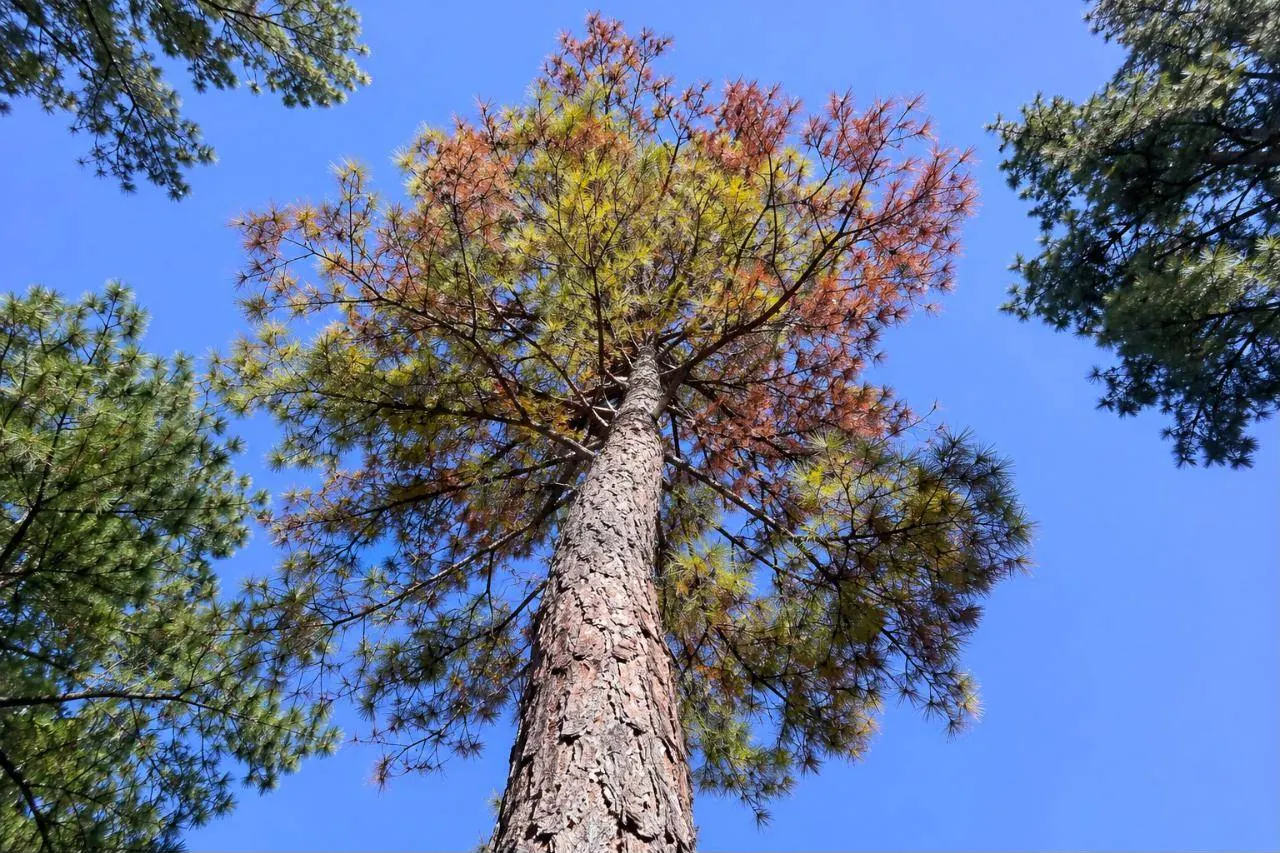
NC State Extension's pine bark beetle publication gives the signs to watch for:
- Pitch tubes. Little lumps of resin on the bark are a good sign of an attack, though a badly stressed tree may not produce them.
- A fading crown. The needles go from green to light green, to yellow, to red.
- A recent stress. Ips engraver beetles are tied to drought, overcrowded stands, storm or fire damage and lightning strikes. Black turpentine beetles favor recently wounded trees.
For southern pine beetle, the publication recommends cutting infested trees along with a buffer of green trees, and calls cutting and removing them the most effective option. For Ips and black turpentine beetles, it says control is seldom warranted, though managers may remove heavily infested trees to cut the risk to nearby pines. Around a house, the bigger reason to take out a beetle-killed pine is simpler: a dead, drying trunk standing over the roof. See dead or leaning trees.
Ice and wind
Ice brings pines down too. The December 2002 ice storm left Duke Power with three-quarters of an inch to an inch of ice across the areas it hit, and the N.C. Utilities Commission found that most outages came from trunks and limbs falling onto distribution lines.
The N.C. Forest Service's bulletin on storm-damaged pines says ice and snow storms cause widespread damage much like a hurricane's: uprooted trees, snapped main stems, broken limbs and crowns, and trees bent or leaning. Young pines that are bent usually straighten within the first growing season. Older ones are a different story. The bulletin expects mature trees with visible root damage, especially those leaning more than 45 degrees, to die, and says heavily damaged trees are best taken out as soon as possible. In a damaged pine stand, it puts trees with sprung roots, broken tops and leans past 30 degrees first in line for salvage. A pine near a house with any of those injuries is worth having looked at quickly.
How a pine comes down near a house
Height is the problem. A loblolly that stands taller than the distance to your roof can't be dropped in one piece toward the house, so near buildings a climber or bucket truck usually takes the top out first and then brings the trunk down in sections, lowering each piece on a rope.
- Near wires. If the top is anywhere near a line, the utility comes first. Monroe Energy Services is at (704) 282-4600, and Union Power's vegetation management department at (704) 289-3145. Duke Energy asks to be contacted before anyone prunes or removes trees near its lines.
- The wood. Monroe doesn't collect trees or limbs cut by a hired tree service, and it bans open burning, so hauling belongs in the price.
- The stump. Grinding it at the same visit needs an NC 811 request three full working days ahead. See stump grinding.
What pine removal costs
Thumbtack's national removal guide, updated March 24, 2026, doesn't list pines separately. It prices by trunk diameter and canopy width, from $226 to $596 for a trunk under 12 inches with a canopy under 30 feet, up to $1,562 to $4,117 for a 24- to 36-inch trunk under a canopy wider than 30 feet. Several pines in one visit, how close they stand to the house and the wires, and hauling are what move a local quote. See what tree work costs.
What commonly goes wrong
- Thinning the wrong trees. Leaving the thin, crowded pines and removing the strong ones defeats the purpose of the 20/80 advice.
- Opening a new edge without a plan. Pines that grew sheltered can blow over once their neighbors are gone.
- Waiting on a red crown. A pine fading to red over the house is a removal to plan now, not a tree to watch for another season.
- Forgetting the wood. Pine logs and brush left at the curb won't be picked up if a contractor cut them.
Questions homeowners ask
Are pines more dangerous near a house than oaks?
Not by species alone. In the University of Florida's hurricane data, loblolly pine survived at about the same rate as Bradford pear and better than southern red oak. A crowded, newly exposed or beetle-stressed pine is the one to worry about.
Can a pine with pitch tubes be saved?
Pitch tubes are a good sign that beetles are attacking, by NC State's account. There's no effective pesticide, the county forester says, so have the tree looked at and watch the crown closely.
Should I take out every pine near the house?
Not automatically. The county forester's advice is to keep the best fifth of a crowded stand and give it room. Your yard may need a different answer.
Can I burn the pine brush?
Not in Monroe, which prohibits open burning. Outside town, burning near woods needs an N.C. Forest Service permit; see the local rules guide.
Your request goes from this site to one independent local contractor. The site doesn't remove pines or any other trees.
- Union County Extension, Pine Trees (January 24, 2023) and Forestry in Union County (December 28, 2021), by the county's urban forester. Union County, Urban Forestry page.
- NC State Extension, Pine Bark Beetles (August 4, 2022).
- N.C. Forest Service, Managing Storm Damage to Southern Yellow Pines (TRB-002, August 2015). N.C. Utilities Commission, December 2002 ice storm executive summary (2003).
- UF/IFAS Extension, FOR119, Selecting Coastal Plain Species for Wind Resistance.
- City of Monroe, Yard Waste page; Open Burning Rules; Energy Services FAQ. Duke Energy, Trees and Safety. Union Power Cooperative, Carolina Country (January 2021).
- Thumbtack, cost to remove a tree, updated March 24, 2026.